

The PTA Christmas Fair Checklist: A Week-by-Week Plan for 2026

Vicki Atkin
When should a PTA start planning a Christmas fair?
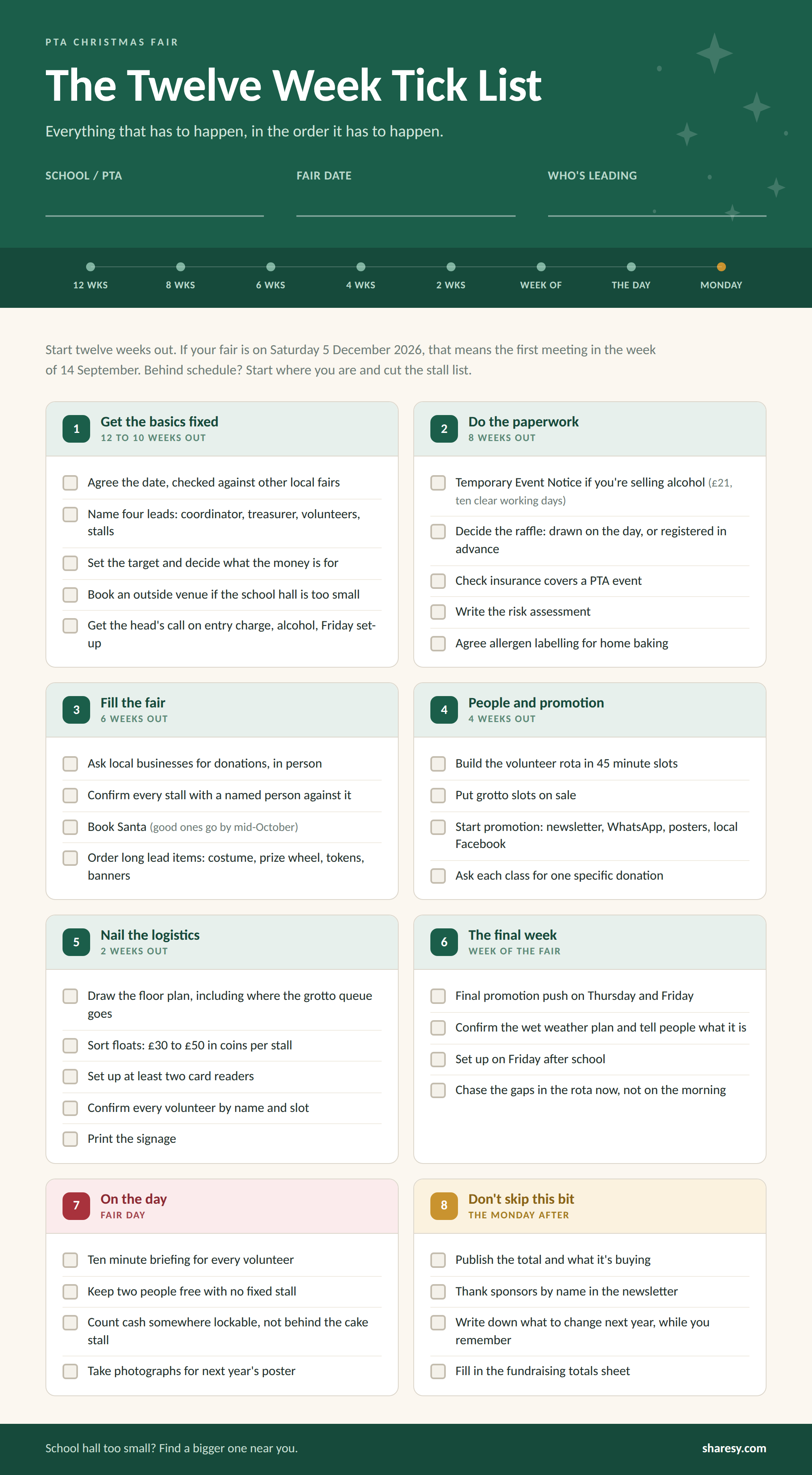
Twelve weeks before the date is ideal. That gives you enough time to book an outside venue if the school hall is too small, apply for licences at the standard rate rather than the late one, and get to local businesses before their Christmas donation budgets are spent.
The short version:
• 12 weeks: committee, date, venue, budget
• 8 weeks: licences, insurance, risk assessment
• 6 weeks: stalls confirmed, sponsors asked, donations coming in
• 4 weeks: volunteer rota, promotion starts, grotto slots on sale
• 2 weeks: floor plan, signage, floats and card readers
• Week of: final push, set-up plan, weather plan
If you are reading this in November, go straight to the four week section and cut your stall list in half. Just make sure you have your licences, insurance and risk assessments in place! A smaller fair that runs properly raises more than a big one held together with gaffer tape and goodwill.
The Christmas fair checklist,week by week
12 to 10 weeks out
Pick the date and check it properly. The first two Saturdays of December are the busiest, which means you are competing with every other school, church and community centre nearby. Late November often does better. Parents still have money and have not started their own Christmas shopping yet. It might be a good idea to ring round two or three local schools and the parish office before you commit.
Name four people, not a committee of twelve. Coordinator, treasurer, volunteer lead,stalls lead. Everyone else helps one of those four. A named person for each area is the difference between a fair that runs itself on the day and one where three people do everything.
Set a target and work backwards. Check your totals from the previous year to guide your target this year. If last year raised £2,400 across fourteen stalls,you already know roughly what a stall is worth. Decide what the money is for before you start asking for it. “Helping the school” raises less than “£3,000 for new reading books in KS1”. A specific goal is much easier for parents to visualise and they know how it is going to improve the children’s educational experiences.
Check the hall against last year's turnout. Capacity, fire exits, whether you can spill into the playground or the corridor. If the numbers do not work, start looking at outside venues now rather than in November.
Get four decisions from the head. Date for the event, entry charge or free entry, alcohol yes or no, and whether you can set up on the Friday after school. All four change the plan.
8 weeks out
This is the paperwork week. It is dull but it is one of the most important bits.
Temporary Event Notice if you are selling alcohol. Mulled wine, abar, beer at the burger stall. It costs £21, you apply to the council at least ten clear working days before the event, and you have to stay under 500 people on site at any one-time including volunteers. A late TEN (five to nine working days) can be rejected outright without a hearing, so do not leave it.
Raffle rules. A raffle where tickets are sold and drawn on the day at the fair usually counts as an incidental lottery, which does not need a licence or registration. The conditions are that there is no rollover, tickets are only sold at the event, and the amounts you take out of the proceeds for prizes and running costs are capped.
Expenses: You may deduct a maximum of £100 frOm the proceeds to cover organisational costs (like printing tickets).
Prizes: You may also deduct a maximum of £500 from the event proceeds to cover the cost of prizes. Donated prizes do not count towards the cap. These figures are from ‘The Gambling Act 2005 (Incidental Lotteries) Regulations 2016’.
If you want to sell tickets in advance, in the playground or online, that is a different category, and your PTA will need to register with the council as a small society lottery. It is always worth double checking what the requirements are for lotteries in your local borough. Do that four to six weeks ahead.
Insurance. Check whether the school's policy covers a PTA event or whether you need your own. If you are a Parentkind member, check what is already included before buying anything extra. Bouncy castles, fairground rides and anything with a generator will need the supplier's own public liability certificate, and you want to see it, not be told it exists. Ask for a copy for your records as well.
Risk assessment. This needs to cover crowd flow, fire exits,hot drinks, cables, stalls, the grotto and lost children. Check what else you are doing at your event and what else needs covering. There will almost certainly be a template from the previous year that you can review, amend and update.
Food. Home baking is fine. Allergen information is not optional, so ask every baker for an ingredients list and write the labels yourself so they are all legible.
6 weeks out
Ask for donations in person. A letter on school-headed paper works, but someone walking into the hairdresser, the garden centre and the sandwich shopworks far better. Give them a deadline and something back: name on the poster,a shout-out in the newsletter, a sign on the stall.
Confirm every stall with a name against it. A stall nobody has agreed to run is not a stall.
Order anything with a lead time. Grotto costume, prize wheel, tokens or wristbands, printed banners. And book Santa. Good local Santas are gone by mid-October.
4 weeks out
Build the volunteer rota in 30 to 45 minute slots. Not two hour ones. People say yes to shorter time slots and they turn up. You need roughly one volunteer per stall plus two on the door, two or more on refreshments and two with no fixed job.
Put grotto slots on sale. This is the single biggest thing you can do for both takings and queue management. Pre-sold slots mean the money is in before the day and nobody is standing in a corridor for 40 minutes with a four year old.
Start promotion. School newsletter, class WhatsApp groups, posters in the shops that donated, local Facebook groups and community noticeboards, the council's what's-on listing, and the nursery down the road. Younger siblings bring whole families.
Ask for donations by class. Reception brings chocolate, Year 1 brings bottles, Year 2 brings toys, and so on. Swap it for a non-uniform day and you will get far more than a general appeal.
2 weeks out
Draw the floor plan. Where the grotto queue goes matters more than anything else on that sheet. Keep food away from the entrance so people get inside before they stop.
Floats and card readers. Around £30 to £50 in coins per stall as a guide, and at least two card readers, ideally more. Cash-only stalls now cost you money. Agree who is banking the cash and where it is counted, which should be a locked room.
Confirm every volunteer by name and slot and send the rota out. Chase the gaps this week, not on the Friday.
The week of the fair
Final promotional push on Thursday and Friday, when parents are thinking about the weekend. Set up on Friday after school if the school allows it. Confirm your wet weather plan and tell people what it is, because “it's on whatever the weather” doubles your turnout on a grim morning.
On the day
Brief everyone in ten minutes at the start: where the loos are, where first aid is, who to find if a child is lost, what to do if a float runs low. Keep two people free with no fixed stall.
The Monday after
Count it, then publish it. “We raised £3,140 and it is buying new reading books for KS1” is the sentence that gets you volunteers next year. Thank sponsors by name in the newsletter. Write down what went well and anything that didn’t while you still remember, because in twelve months you will not.

What paperwork does a school Christmas fair need?
Four things, in this order:
1. A risk assessment. Always. The school should have a template.
2. Insurance cover. Either the school's policy extended to the PTA, or the PTA's own, plus public liability certificates from every outside supplier.
3. A Temporary Event Notice (TENS) if alcohol is being sold. £21, minimum ten clear working days' notice, under 500 people on site.
4. Lottery registration only if raffle tickets are sold before the day. Tickets sold and drawn at the fair itself do not need it.
You do not need a street trading licence foran event held inside school grounds. You do need one if stalls are on thepavement outside, and that comes from the council.
What if the school hall is not big enough?
If your hall holds 120 and 300 people came last year, that is not a problem a floor plan will solve. It is worth pricing up a church hall or community centre within walking distance, particularly if the school site has parking problems.
There are 667 halls, church halls and school halls listed for hire across London on Sharesy, from £18 to £147 an hour, with most sitting around £45. A hall that holds 150, booked for a five hour block including set-up and clear-down, usually lands somewhere between £150 and £250. Against a fair that raises a few thousand pounds, that maths often works.
A few that suit a fayre:
• The Leahy Hall at St Mary at Finchley, 200 capacity, from £23 an hour
• Grange Park Methodist Church main hall, 120 capacity, from £46 an hour
• The Rock Hall, 300 capacity, from £130 an hour
Six things to check before you book anything: what time you can get in to set up, whether tables and chairs are included,whether the kitchen is usable, whether alcohol is allowed, where people park, and whether you can store anything overnight on the Friday.
You can browse halls for hire in London by capacity and price, or narrow it down to your area, for example venues in Barnet.
Five things that make the biggest difference
1. Pre-sell the grotto. Money in early, no queue on the day.
2. Card readers on every stall. Nobody carries cash and usually the cashpoint is not nearby.
3. 30 to 45 minute volunteer slots. Short asks get said yes to.
4. Donations requested by class. Specific beats general, every time.
5. Publish the total and what it bought. This is next year's recruitment done for you.
Christmas fair FAQs
How long does it take to plan a school Christmas fair?
Twelve weeks is comfortable. Eight is doable with a smaller stall list. Under four weeks, run a smaller event and do the full fair properly next year.
Do you need a licence to sell alcohol at a school Christmas fair?
Yes, unless the venue is already licensed. You need a Temporary Event Notice from the council, which costs £21 and needs atl east ten clear working days' notice. Your event has to stay under 500 people at any one time.
Can a PTA run a raffle without a licence?
Yes, if tickets are only sold at the fair and drawn at the fair, with no rollover. That is an incidental lottery and needs no registration. Selling tickets in advance means registering with your council as a small society lottery, so allow four to six weeks.
When is the best date for a school Christmas fair?
Late November or the first Saturday in December. Later than that and you are competing with parents' own Christmas plans, and every other local fair.
How many volunteers do you need?
Roughly one per stall, plus two on the door, two on refreshments and two floaters. For a fourteen stall fair that is around twenty people, split across 45 minute slots.
What makes the most money at a Christmas fair?
Santa's grotto, the raffle, refreshments and the bottle or jar tombola usually. Craft stalls and games are what keep families in the building long enough to spend at the first four.
Need somewhere bigger than the school hall? See halls for hire in London with prices, capacity and instant availability.
Looking for a venue?
Find a venue for your next one off event or get help finding a space for your recurring sessions.
Find a venue


