

How to Find a Weekly Venue for Your Class or Club

Vicki Atkin
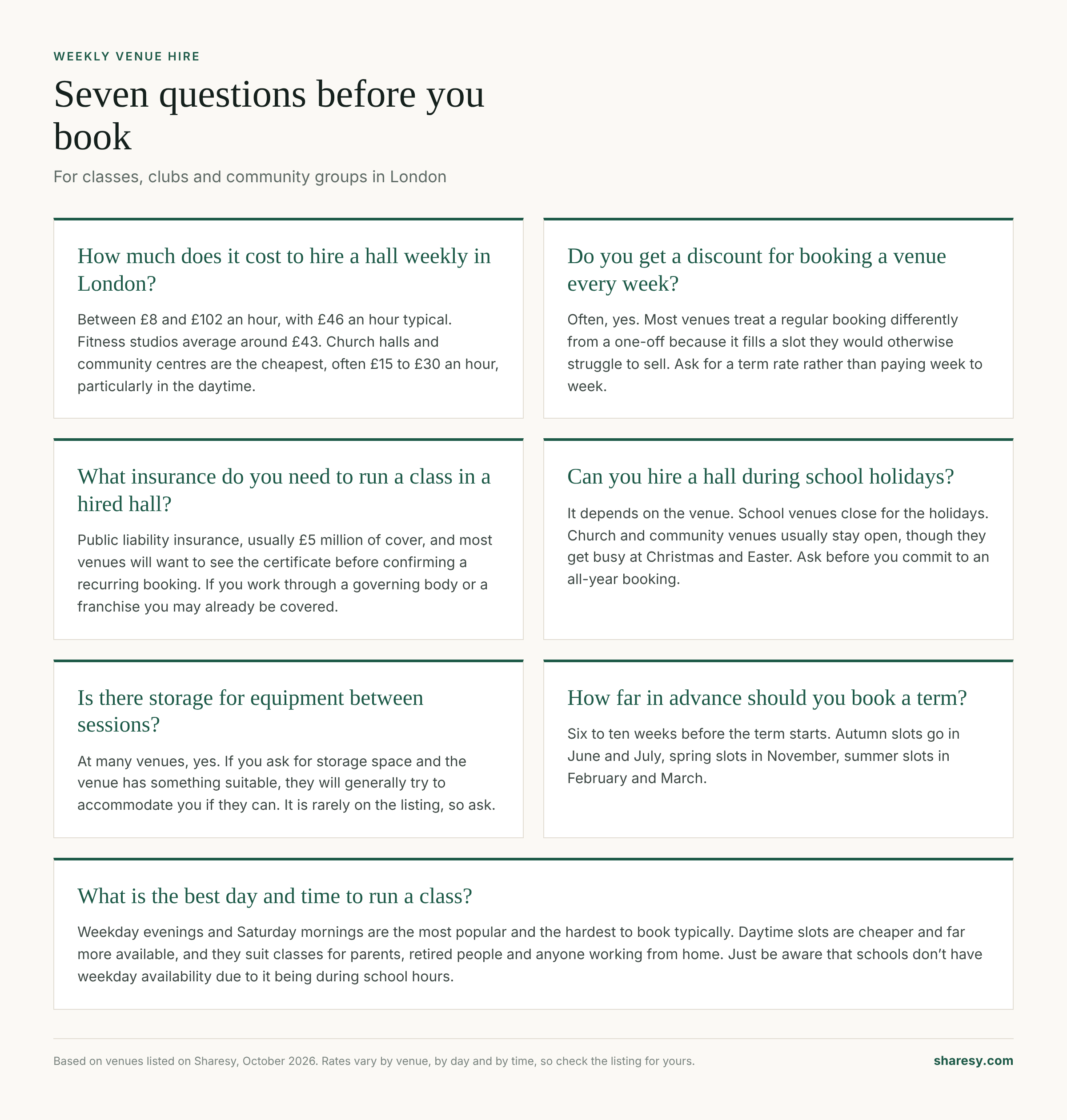
A weekly venue hire slot in London costs between £8 and £102 an hour on average, with £46 an hour typical across the 1,000 plus spaces available on Sharesy in London for recurring hire. For a fitness studio specifically, it is about £43 an hour, and there are plenty under £25.
Searching for a venue on Sharesy is the easy part. The harder part is trying to find; the venue you can afford, that your guests can get to and that is available at the time you want it.
Here is the whole process, in the order it actually happens, when booking a space for your recurring sessions.
What can you afford to pay?
Work this out before you look at a single venue, because it rules out the ones that are out of budget instantly. With Sharesy’s filters, you can sort venues by price which makes your search so much quicker.
Take what you will charge per person and the number you realistically expect in the first term. Not the number you hope for by the summer. Most of your costs are fixed. The room costs the same whether six people turn up or sixteen, and so do your insurance and your kit. That makes the sums straightforward, and it also means a quiet week comes straight out of your pocket.
Add up what one session costs you: the room, your insurance spread over the term, equipment, anything you spend getting people through the door. Divide that by the number you realistically expect. That is your break-even price per head. Charge above it and the difference is yours.
Say you charge £8 a head and ten people come. That is £80 in.
Now the room. A one hour class is never a one hour booking. Generally, you need to add fifteen minutes to set up and fifteen to clear and you are paying for ninety minutes. At £46 an hour that is £69.
So £80 in, £69 out, and you are left with £11. That £11 has to cover your insurance, your kit, your time planning the session and anything you spend getting people through the door. It is not a great profit margin.
That gives you a ceiling, and the ceiling is usually lower than people expect. For the class above, £30 an hour is the realistic top end, which means looking at church halls, community centres and smaller rooms rather than dedicated studios.
Two things change the price in your favour:
• Book the room for less time. If you can set up in five minutes rather than twenty, you are buying an hour instead of ninety minutes. Some venues bill in half hours, some in whole ones. It matters. Some venues ask you to account for your set up and clear up time in your booking so make sure you have realistic timings so you don't go over your stated time was or you may be charged extra.
• Run two classes back to back. Two one hour classes with fifteen minutes either side is a two and a half hour booking, not three, because you set up once and clear once rather than twice. At £46 an hour that is £57.50 a class instead of £69. It is also one journey and one load of kit rather than two. And running two sessions in the same hall on the same day can be much more efficient and cost effective.
Which day and time should you go for?
The slots everyone wants are weekday evenings and Saturday mornings. Those are the hardest to get, they go first, and they are where you will pay the most.
Daytime slots are cheaper and far more available. If your class is aimed at parents of toddlers, retired people, shift workers or anyone working from home, a Tuesday at 11am is a better booking than a Tuesday at 7pm.
If you need an evening, be flexible about which one. Monday and Friday evenings are noticeably easier to book than Tuesday and Wednesday.
And think about the term calendar before you commit to a day. If your class is for school-age children, you are working around clubs, swimming lessons and homework, and Friday afters chool is a very different proposition from Monday.
How far will people actually travel?
Further than you think for something they cannot get elsewhere, and not at all for something they can.
If you are running a yoga class in an area with four other yoga classes, your catchment is roughly about a fifteen minute walk. If you are running the only language school, the only dementia-friendly choir or the only under-seven's fencing club in the borough, people will often drive for it.
Be honest about which one you are. It decides whether you are choosing a venue by postcode or by price.
Three practical things that matter more than distance:
• Parking. For anything involving equipment, buggies or older people, parking is the single biggest factor in whether people come back. If it is easy to get to you that is a big win.
• The walk from the bus stop or station. Five minutes in daylight is not five minutes in January at half past seven.
• Somewhere to wait. A corridor where parents can stand for an hour, whilst their child is attending a session is worth more than you would guess. So is a car park they can sit in.
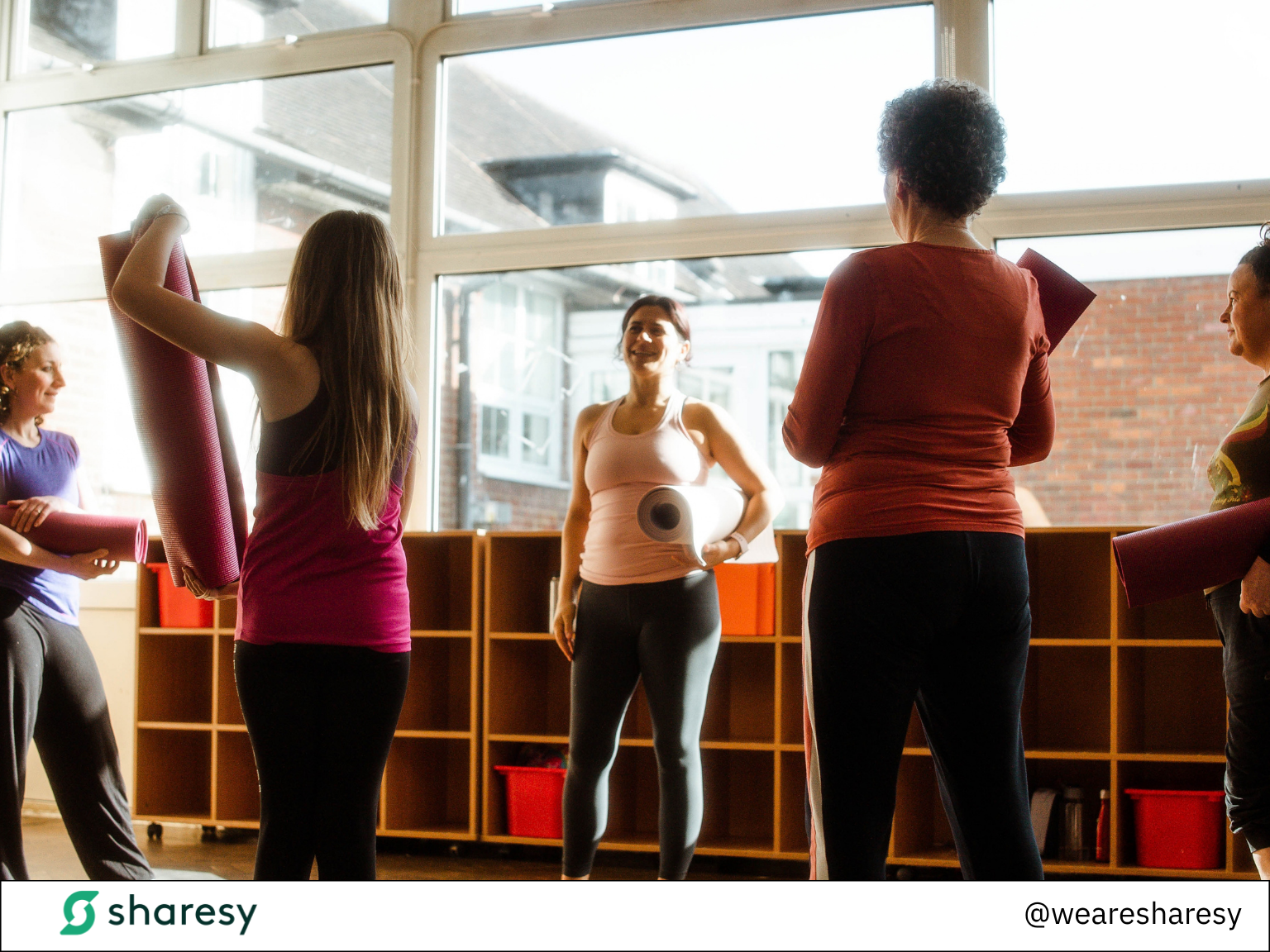
Which kind of venue suits which class?
Church halls and community centres are the default for most groups, and for good reason. They are the cheapest, they usually have a kitchen, tables and chairs already in the building, and they are used to regular hirers. The floors vary a lot, so check before you book anything involving bare feet or a lot of jumping.
Typical rates: £15 to £50 an hour, with a handful of small rooms under £10.
School halls and classrooms are bigger, well equipped and usually available outside school hours only, which in practice often means weekends. They close for school holidays, which for a term-time class is a feature rather than a problem. Expect a caretaker on site and a more formal booking process.
Typical rates: £25 to £60 an hour.
Dedicated studios have the floor, the mirrors, the sound system and the ceiling height. They cost more and they are worth it for dance, martial arts and anything where the surface matters. Check the opening hours carefully, because a good number are daytime only.
Typical rates: £30 to £98 an hour.
Sports halls, gyms and courts are for anything that needs the space or the markings. Availability is the constraint rather than price.
Here are a some of our Sharesy venues that are perfect for recurring bookings.
• The Committee Room at St Mary at Finchley, 30 people, £15 an hour. A small meeting-sized room, the sort of thing a book group, a language class, a baby and toddler group or a committee needs.
• Zenw2 Wellness Space in NW2, 30 people, £17 an hour. A great space for yoga, wellness sessions or coaching sessions.
• Blue Hut Gym in N1, 6 people, £20 an hour. Small group personal training rather than a class.
• The Leahy Hall at St Mary at Finchley, 200 people, £23 an hour midweek. Great for larger classes, toddler stay and play sessions or a dance class.
• The Unit Spaces Islington, 10 people, £31 an hour. A small but perfect space for training sessions, workshops or even rehearsals
• The Lower Hall at The Amadeus in Maida Vale, 60 people, £51 an hour on weekdays. The listing says this rate is specifically for small workshops, yoga classes and small events, which is a good sign that the venue understands regular hirers. There is a piano and on-site staff.
• Main Hall at Chalgrove Primary, 150 people, £54.82 an hour, weekends only. A stage, a caretaker on site and step-free access. No kitchen and no alcohol.
• Studio 1 at Rhythmic Health in EC1R, 40 people, £57.50 an hour, weekdays between 7.30am and 5.30pm. A Harlequin sprung floor and full-height mirrors, so it is the right room for dance, and only if your class runs in the daytime.
Not quite right? There are over 1,000 London venues taking weekly bookings, so it is worth a look through the rest.
What paperwork will a venue ask for?
This is a really important step as you need to make sure you have everything you need to run your classes at avenue. Have all of it ready before you enquire as venues will ask to have copies of it before your sessions start.
Public liability insurance. Almost every venue will ask and most want to see the certificate rather than take your word for it. Cover of £5 million is the common requirement for a class in a hired hall. If you teach through a governing body or a franchise, you may already be covered, so check before buying your own.
A DBS check if you are working with children or vulnerable adults. The venue will ask to see it. Some schools and churches ask for an enhanced check specifically.
A risk assessment. This needs to cover what could go wrong, what you have done about it. The venue may have a template, and if they do not, it is important to have one.
A safeguarding policy if children are involved. Church and School venues will usually ask to see your policy.
A Health and Safety Policy. This is also an important document to have in place to and it may be asked for by the venue as well.
Your qualifications. Expect to have them to hand as well.
None of this is difficult. All of it takes a bit of time to assemble, which is why it is worth doing before you find the room rather than after.
Term time or all year round?
It depends more on your venue than on your class.
School venues close for holidays. Thirteen weeks a year you have nowhere to go, which is fine if your class is term-time anyway and a real problem if it is not.
Church and community venues usually run all year, though they get busy around Christmas and Easter and some will move you for a carol service or a fete. Ask what happens on those dates before you commit.
The honest answer for a new class is to start term-time. It is a shorter commitment, it matches what your members expect, and if the class does not work you have not signed for fifty-two weeks of a room you cannot fill. You can always add the holidays later and holiday clubs are usually a separate and better-paid thing anyway.
How do you get the best rate?
Regular hirers are worth more to a venue than one-off bookings. A weekly slot fills a gap in the diary that would otherwise sit empty and you are a known quantity.
Often our Sharesy venues have arecurring booking rate, so it is always worth asking the following:
Ask for a term rate rather than a weekly one. Booking twelve weeks in one go might include a discount, and it also means nobody else can take your slot halfway through as these are then blocked off in the venue calander for you.
Ask about the quiet slots. If you can move your class from Tuesday at 7pm to Tuesday at 11am, say so and ask what it saves. Daytime is where venues have space they cannot sell. The pricing on each listing will show you if there is daytime verses evening price difference.
Ask about storage. Many venues will give a regular hirer a cupboard, a rack or a corner for mats and equipment. This is worth real money if the alternative is carrying everything in your car twice a week, and it is rarely advertised.
Be a good hirer. Leaving the room as you found it, paying on time and telling them in advance when you are away is not just courtesy. It is the reason you will get the slot again next year when someone else wants it.
What to check before you commit
Go and see it, at the time of day your class will run, if possible. A hall at 10am on a Wednesday is a different building from the same hall at 7pm.
• Is the floor right for what you do? Sprung, solid, carpet, lino.
• What is the heating like, and who controls it?
• Is there another booking either side of yours, and does that leave you time to set up?
• Where do people wait, and where do they put their coats?
• Is there a kettle, and is the kitchen included or extra?
• What is the sound like, and can you play music?
• How do you get in? Keys, a code, someone meeting you.
• What happens if the hall is double-booked or the heating fails?
• Wha tis the notice period on both sides?
That last one matters more than any of the others. Ask how much notice the venue has to give you if they need the room back and get the answer in writing.
Find a regular slot in London with the day, the time and the hourly rate on every listing, so you can work out what it costs before you enquire. If you are after a studio specifically, start with fitness studios for hire.
Looking for a venue?
Find a venue for your next one off event or get help finding a space for your recurring sessions.
Find a venue


